Most Philippine businesses are not short on leads. They're running Facebook ads, boosting posts, maybe spending on Google. Inquiries are coming in — DMs, form fills, Viber messages. The numbers look fine on paper.
The problem is what happens next.
Leads go cold. Sales teams follow up once, maybe twice, then move on. The landing page they're sending traffic to hasn't been touched since the campaign launched. There's no sequence, no nurture, no system — just a hope that the people who clicked will eventually decide to buy. Some do. Most don't. And the business owner, reasonably, concludes that the ads aren't working.
The ads are usually fine. The conversion system is broken.
The Difference Between a Lead and a Conversion System
A lead is an expression of interest. A conversion is a decision. These are not the same thing, and treating them like they are is the single most expensive mistake in Philippine digital marketing.
When someone fills out a contact form or sends a "how much po?" message, they haven't bought anything. They've raised their hand. What happens in the next 24 to 72 hours — how fast you respond, what you say, where you send them, what they see when they get there — determines whether that hand-raise becomes a sale or a statistic.
Most businesses have no structured answer to any of those questions. They have a sales rep and a Viber group. That's not a system. That's a hope.
A real conversion system has three parts: the destination (what the lead sees first), the follow-up (what happens immediately after they inquire), and the sequence (what they see and hear over the next few days or weeks). In most Philippine businesses we encounter, at least two of these three are either absent or broken.
Why the Landing Page Is Usually the First Problem
The most common scenario we see: a business runs a well-targeted Facebook ad, spends real money on it, and then sends every click to their homepage.
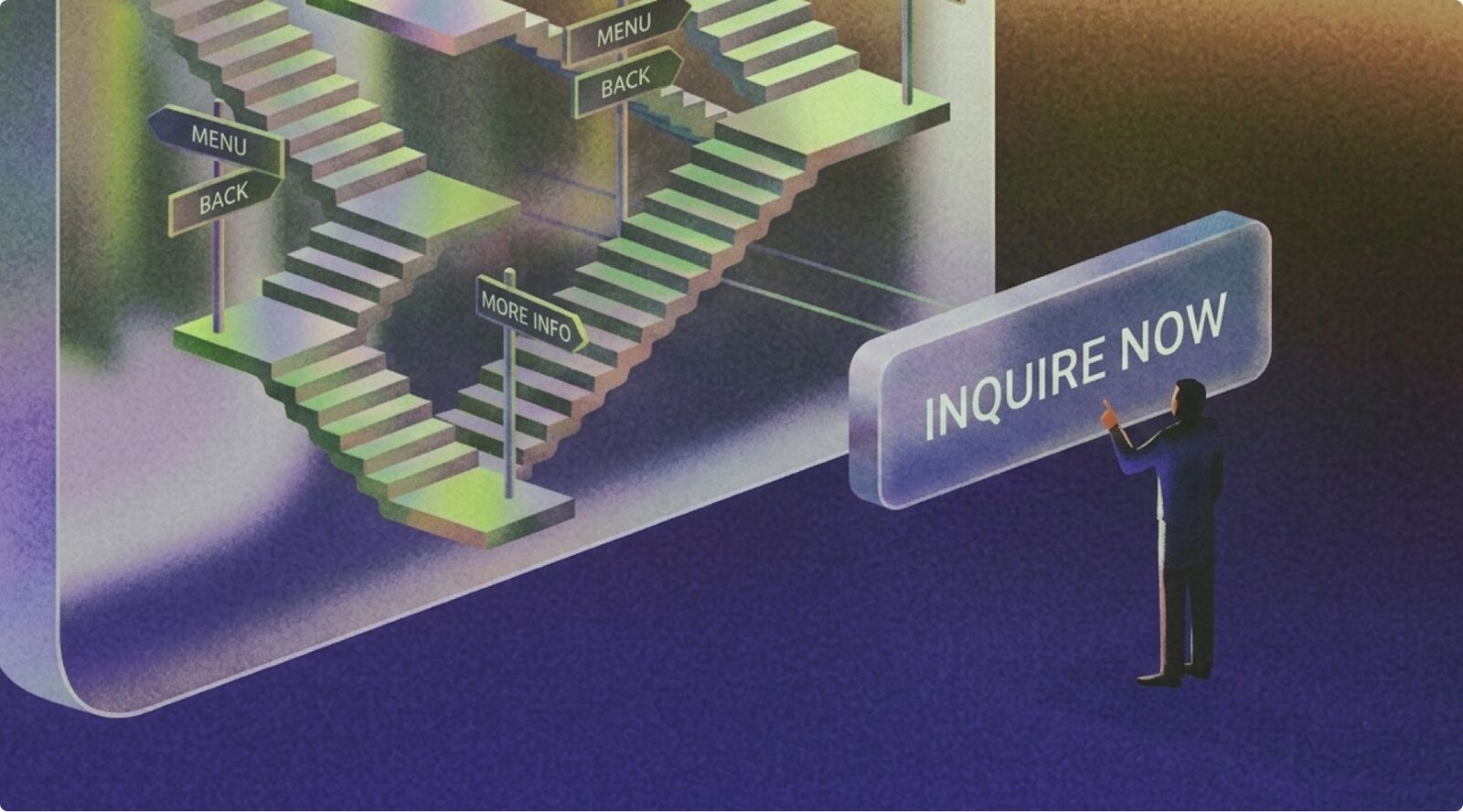
A homepage is not a landing page. It's a company brochure. It has navigation, multiple CTAs, links to the About page, a news section that hasn't been updated since 2022. It's designed to orient, not to convert.
A landing page does one thing. It takes the exact promise in the ad, continues that promise on the page, and gives the visitor a single action to take. No detours. When that alignment breaks — when someone clicks an ad for a discounted condo unit and lands on a homepage full of development projects — the conversion rate drops, usually to near zero.
When we rebuilt the inquiry flow for one of our property developer clients, the brief we were handed included five different CTAs, a project carousel, and a contact form buried three scrolls down. We stripped it back to a single page, a single offer, and a single button. The client's sales team started getting qualified inquiries within the first week — not more inquiries, but better ones from people who had already self-selected based on the specific offer they clicked. That's what a properly built landing page does.
Speed and Follow-Up: The Problem No One Wants to Admit
There's a widely-cited principle in sales that the odds of qualifying a lead drop by 80% if you don't respond within five minutes of an inquiry. That number may be approximate. The underlying truth isn't.
Filipino consumers who inquire online are often doing it from their phones, during a commute, during a lunch break. They're not waiting at their desk for a reply. If they don't hear back quickly, they move on — to the next option, to a competitor, to forgetting they ever inquired.
Most businesses we work with have a response time of 24 hours or more, sometimes days. By the time someone follows up, the lead has either found an alternative or completely lost the context of why they were interested in the first place.
This is fixable. Not through hiring more people, but through automation and sequencing — a structured set of messages that go out immediately when someone inquires, that restate the value, that make it easy to take the next step. It doesn't need to feel automated. It just needs to arrive while the person still cares.
The Nurture Gap: Most Leads Aren't Ready to Buy Yet
Here's the part that most businesses find counterintuitive: the majority of people who inquire about your product or service are not ready to buy right now. They're comparing. They're budgeting. They're waiting for the right moment. This is especially true for higher-consideration purchases — real estate, professional services, business-to-business contracts.
In the Philippines, this consideration period can be long. Family consultations happen. Budgets need approvals. Decision-makers need to be convinced.
A business without a nurture sequence assumes that if a lead doesn't convert within a few days, they're dead. So they move on. What they've actually done is abandon a warm lead to a competitor who kept showing up.
Nurture isn't complicated. It's a sequence of emails or messages over two to four weeks that keeps your business visible, builds credibility, and answers objections before the sales conversation happens. Done well, it turns a "not yet" into a "yes" — often without a follow-up call at all.
Frequently Asked Questions
How do I know if I have a lead problem or a conversion problem?
If you're getting inquiries but not closing deals, you have a conversion problem. If you're barely getting any inquiries at all, you may have a targeting or ad problem. Track how many inquiries you receive versus how many turn into actual customers — if that ratio is low (below 10–15%), the issue is almost certainly in your conversion process, not your ads.
We have a CRM. Shouldn't that be solving this?
A CRM tracks leads — it doesn't convert them. Plenty of Philippine businesses have tidy pipelines full of cold contacts because the follow-up sequence was never built in the first place. Software doesn't fix a missing process. It just makes the gap more visible.
We're a small business. Do we really need all this?
The basics — a proper landing page, a fast initial response, and a short follow-up sequence — are achievable for any business of any size. You don't need an enterprise marketing stack. Even a simple three-message Viber sequence sent within an hour of inquiry will outperform doing nothing.
Conclusion
Getting a lead to pay attention is hard. Getting them to convert is a different skill entirely — and it's one that most Philippine businesses haven't built yet.
The fix isn't more ad spend. It isn't a new social media strategy. It's designing what happens after the click: the page they land on, the message they receive, the sequence that keeps them moving toward a decision. These aren't creative problems. They're structural ones.
And structural problems have structural solutions — which means most businesses are one good system away from getting real value out of the leads they've already paid for.